
Sebi has said investment banks should direct investors to original sources such as stock exchanges, where data is publicly available.

More cos could join the likes of Burger King and Antony Waste in giving listing another shot.

Rakesh Jhunjhunwala has picked up a 1.29 per cent stake in Tata Motors. The September quarter shareholding pattern disclosed by the automaker showed Jhunjhunwala holding 40 million shares.


China is the world's second-largest - both in terms of GDP and m-cap. At $10 trillion, its m-cap is second only to the US at $38 trillion.
Many are now hoping the markets remain in good stead as they look to finalise the dates for IPOs, such as UTI MF, Computer Age Management Services, Happiest Mind, and Angel Broking. Most of the issues are expected to come to the market in the second half of September.

About Rs 4,257 crore worth of bids have been received so far and the Centre hopes that retail investors - those investing up to Rs 2 lakh - will place bids worth at least Rs 750 crore.

In the past four months, $7.5 billion has flowed back into domestic stocks, helping the benchmark indices bounce back more than 40 per cent from their 2020 lows.

The V-shaped rebound has been aided by a gush of liquidity flooding the global financial system, thanks to balance sheet expansion.

What worked for the markets was favourable global investor sentiment and encouraging flows into the emerging markets following stimulus measures taken by central banks.
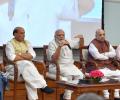
Many changes are likely in the BJP and government in coming weeks.

Market experts said disruptions caused by the pandemic - to businesses as well as the filing process - and the sharp decline in valuations were the reasons behind fewer new companies wanting to tap the capital markets.

Karnataka, Meghalaya, Punjab, Gujarat, Rajasthan, Telangana and Haryana have partially resumed operations.

Both indices are down nearly 9 per cent from their all-time highs in mid-January. A sharp reversal seems difficult this time as the peak impact of the virus is yet to play out.

At issue size of Rs 10,355 cr, the offering will be Asia's biggest this year and fifth-largest domestically.

The government holds 90 per cent stake in ITI which is valued at Rs 7,550 crore.

The Street was hoping that investors will lap up shares of high-dividend companies on optimism that their payouts will increase further, thanks to the 20 per cent tax saving. However, the trade failed to materialise as wealthy investors stayed away fearing high tax outgo, and experts raised doubts on whether companies would actually increase cash dole outs.

In May 2019, Sebi had penalised the NSE as well as two of its former heads - Narain and Chitra Ramkrishna - for allowing Sampark to provide the dark fibre connectivity to stock brokers, despite not having the authorised licence. Dark fibre refers to an unused optical fibre used for high-speed connectivity.

We followed the highest standard of corporate governance and disclosures, says Nilekani.

The companies that have seen sharp erosion of market wealth include YES Bank, Indiabulls Housing Finance, Zee Entertainment, Vodafone Idea, and Bharat Heavy Electricals.
